
Middle school Bible
Bible is a separate class devoted to Scripture. We write the curriculum in-house for our students, and spiritual growth is the focus of the class.
Upper School: 6th-8th grade
Spring Hill Christian Academy, a private middle school in Spring Hill, TN, teaches 6th grade through 8th grade on campus five full days each week. Your child will reason through questions, write from sources, conduct experiments, make maps, and give presentations. These grades form the logic stage of our classical education, with an emphasis on reasoning and critical thinking. Our Christian middle school (some families call it junior high) is part of one school serving kindergarten through 8th grade.
Schedule a tour
The essentials below show the grades, schedule, and weekly rhythm your child would join.
Before middle school, students attend our Lower School from kindergarten through 5th grade. You can read about 1st through 5th grade on our elementary school page.
Your child will encounter each subject through particular habits of work, from chanting grammar definitions to interpreting an experiment.
Bible is a separate class devoted to Scripture. We write the curriculum in-house for our students, and spiritual growth is the focus of the class.
Each lesson opens with arithmetic facts, mental math, and a warm-up problem. The teacher then introduces one new concept in a small step, and students practice it. Longer sets mix new and earlier work, while regular hands-on investigations and cumulative tests check what students retain. Students move from fractions, decimals, and ratio to proportion and negative numbers. Students then begin algebra with equations and inequalities involving an unknown, rate-based word problems, and roots.
Science uses a program from Apologia and treats the natural world as the work of God. Students discover through hands-on lessons, run experiments with ordinary household materials, and learn the scientific method by name. Students first keep an informal lab report, a written account of an experiment, and later use a formal structure to record and interpret what happened. Teachers show students how to take notes in a notebook, and students read and construct graphs so their written work follows a scientist’s practices.
History uses BiblioPlan to tell world, biblical, and American history as one connected story. Each week also includes church history and a short biography of a Christian figure. Geography turns the reading into handmade maps: students label countries, color waters, and draw route symbols. Older students also answer a harder question on each map. Literature meets most days as a separate period, and students read and study books from the historical period under study. Those books let students encounter the same period again through its writing.
Using Shurley English, students learn grammar definitions as jingles, short rhythmic lines they chant or sing. To examine a sentence aloud, they ask a set sequence of questions about each word in turn, then label the job that word performs. At this level, they work with sentences containing more than one clause, verb forms acting as nouns or adjectives, and active and passive voice. They mend choppy or rambling sentences, edit their own drafts against a checklist, distinguish fact from opinion, and spot propaganda techniques.
Writing uses IEW in all three grades, and each piece begins with notes before drafting. Students build a key word outline, a plan of important words from a source, speak from it, and then write in their own words. Reports grow from one source to several, with an opening, closing, and source list, and thesis essays answer prompts that ask students to give an opinion, compare, or argue a case. Critiques summarize a story and then judge it.
Every middle school student studies Latin, and it appears on the schedule most days. Vocabulary includes everyday words for animals, the human body, and family, and students chant noun and verb endings aloud. Students trace English words back to their Latin origins and translate short Latin sentences, careful work that lets them begin seeing Latin within English.
Students give presentations in all three grades, including persuasive speaking in which they make a case aloud before others. Recitation is part of each day’s opening: students say aloud memory work they have learned by heart.
Music is a class of its own, and students study composers from the period being covered in history. In art, students study artists from that same period and produce their own interpretations of master artists’ works.
Physical education is a subject of its own. Classes work on healthy fitness habits, teamwork, and good sportsmanship, and students try a range of sports.
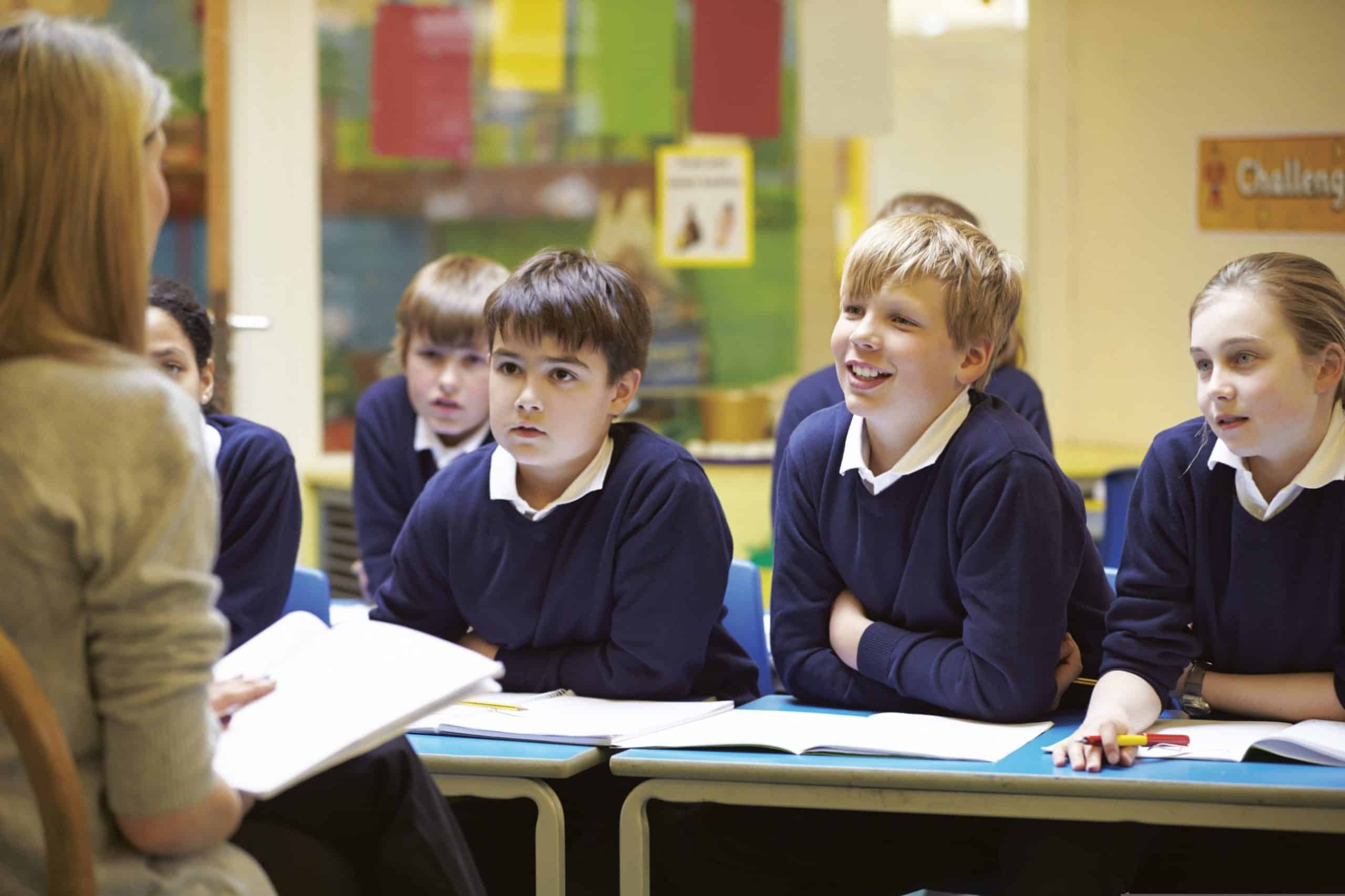
In the logic stage, classroom discussion gives your child a practical way to work through ideas. In Socratic discussion, the teacher asks questions and students talk through their reasoning aloud. They give reasons for an answer rather than only stating it.
Students also learn selected material by heart. They memorize the names of Middle Eastern countries and locate each one on a map. Other memory work includes Job 19:25-27, Psalm 51, a poem by William Blake, and class memory verses. You can read more about the stages of classical Christian learning.
Biblical integration is part of every class, so teachers bring a biblical worldview into the subjects your child studies.
Schedule a tourStudents also open each day with devotions, and every student attends chapel on Fridays at 9:00 a.m.
Arrival begins with copywork before 8:00 a.m. Students write out a passage by hand for a quiet start. At 8:00 a.m., the day formally opens with pledges, devotions, and recitation.
Latin follows most mornings, and mathematics is taught every day. After a 10-minute snack, students have Bible, physical education, or music, depending on the day, and then literature. A 45-minute lunch period comes before the afternoon’s work. Science meets most days, followed by grammar or writing and then history or writing.
Students gather their belongings at 2:45 p.m., and dismissal follows at 3:00 p.m.
Three times a year, in fall, winter, and spring, every student takes easyCBM in reading, mathematics, and English mechanics. This gives you a regular check on your child’s learning during the year.
You receive a progress report midway through each quarter and a report card when the quarter ends. We meet with you for a formal parent-teacher conference during the first quarter.
Tuition and fees appear on our tuition page. When you are ready to apply, our admissions page explains each step.
The teachers all challenge the students to grow and we see it in our kids each day they come home.
I feel a sense of security knowing my kids are in a safe environment, not only from physical harm but those negative influences that can impact their formative years.
Here are the practical details about homework, joining SHCA, phones, uniforms, lunch, and activities.
Teachers set homework individually, and students average approximately 45 minutes each weeknight. That estimate can help you plan your family’s evenings.
Admissions includes placement testing in reading, math, and English mechanics, so we understand your child’s current skills before school begins. New students can also join during the school year after acceptance if their class has no waitlist. The admissions page gives the complete application process.
Yes. Your child may bring a phone for emergencies or to reach you, but it stays in a backpack, out of sight and unused, during school hours. Tablets and watches that can act as phones follow the same rule.
Students wear uniforms, and lunch is brought from home. A hot lunch is available for purchase on Fridays, and no peanut products are allowed.
Students take two field trips each year, one in the fall and one in the spring. The after-school running club meets in the fall and holds one 5K each year.
A 45-minute guided visit is a simple next step before you decide. You pick the time when booking, and a staff member leads your family around campus, shows you the classrooms, and introduces you to our staff. There is no obligation to apply.
Schedule a tour